In Montenegro, I am that stranger suffering profound language incompetence. Though surrounded by people speaking their mother tongue, my incompetence made their words feel like noise. Here I could feel the culture, but I could not participate in its wit, its gripes, or its secrets. I could only make out solitary English words. I am feeling the stark isolation of being in a city that just won’t speak back.

I walked through the tangle of streets in Podgorica, probing the shelves of its Highstreet bookshops, hoping to find a contemporary English Novel I could call their own. Days passed and I am left with little or no choice. I sought for ‘Catherine the Great and the Small’ by Olja Knezevic, which is considered the first contemporary novel by a Montenegrin woman author to be published in English translation. Although I wondered at what must have been lost in translation, there was no copy to be seen, held or read.
I was excited to find Ivo Dandrick’s ‘The Bridge on the Drina’ (Na Drini ćuprija); a novel instrumental to his winning a Nobel peace prize for literature in 1961. Though from the Balkans, Ivo Danrick is profiled as a Serbian author, writing long before Montenegro declared independence.
A part of me is proud of Montenegro for proudly flaunting their mother tongue in a world where English oppresses other languages, but the other part of me mourned the fact that in this Balkan nation, I may not learn about this beautiful country, or these tall, gorgeous men and women of the black mountains who I admire, through the lens of their novels. I had questions I wanted to answer: in this land where people carried themselves with pride, wrapped in quiet dignity, how does poverty reveal its face? In its quiet performances of being, are boys and girls blooming differently, do their men and women radiate differently? what are the norms the land whispers to its children from the cradle? But like many other spaces across the world, this one has not folded to yield to me answers that are dressed in English.
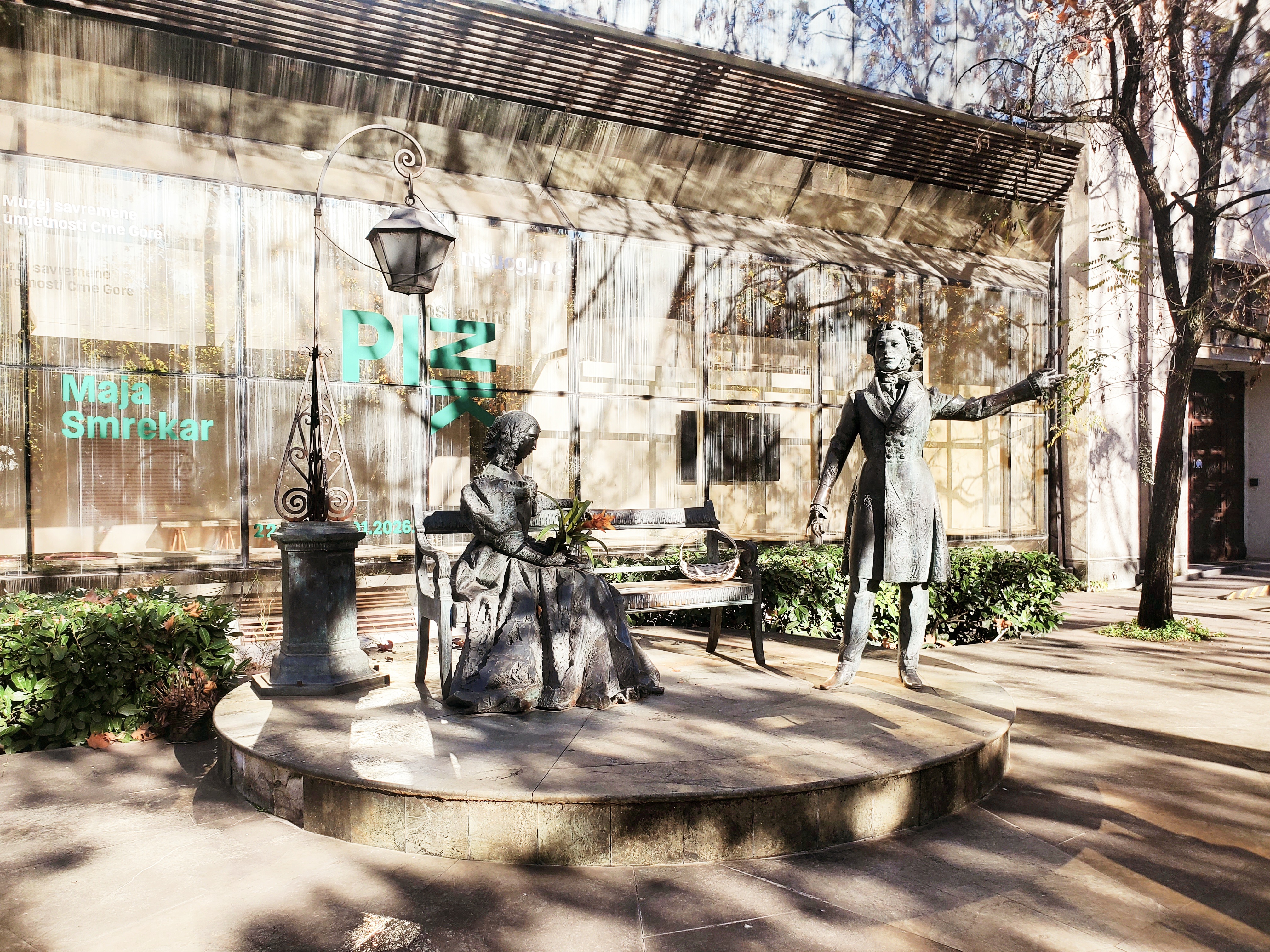
Gradually, I am accepting that I am nursing my entitlement, expecting every shore to echo the language I know and that every country’s pen must ache to bleed in English. Why am I am here desiring that their stories are stripped down and re-dressed in English? I dial up my inner conflict, and it ripples on me: ‘If I cannot speak their language, why should I expect them to read or write in mine?’ I feel a sting of guilt identifying with English language as mine at the expense of the Igbo that first shaped my world. Therein lies the lingering impact of colonization. I feel a quiet shame knowing that the people of Montenegro hold their mother tongue with fiercer pride than I have ever managed of mine, which I rarely write or read in; indeed there is a silence on the shelf of Igbo language. But then, staring across these bookshelves in Podgorica, I am wondering how their stories will travel?
Still, Montenegro is not bowing! she is standing in the pride of her own tongue, with stories that do not hunger for the translator’s hands. This city has refused to be a footnote and I am making peace with the hush it keeps, knowing that the black mountain and its watchful hills will continue to cradle their secrets close.
Written by~ Adaobi Nkeokelonye